Monday, July 12, 2010

Maritime Monday: The Fate of the FAME

In the book "My Recollections of Early Grand Lake," George H. Kauffman tells the tale of how his grandfather (and most well-known pioneer of Presque Isle Township) John Kauffman sailed from Germany at the age of 14 for the United States. Once arriving in Detroit, he got work on a bark called the FAME, and the ship headed north on Lake Huron. The year was 1854.

A storm hit, and upon rounding the point at the Old Presque Isle Lighthouse, the ship capsized and John floated ashore near one of the only structures in the area, a long wooden dock owned by Frederick Burnham. As the old story goes, though he escaped with his life, all of his money and possessions were lost in the wreck. With no money to continue his journey, he decided to stay put where he was and earn money bringing lumber down to Burnham's dock, where steamers would stop and pick up wood for fuel. John would settle in the area and remain there for the rest of his life, other than his time of service in the Civil War.

Fast forward to 1887. After escaping a series of over 10 other accidents, a ship called FAME flounders and is driven ashore at the Old Lighthouse. Finally incapable of sailing again, the ship is disassembled and her timbers are incorporated into the Old Lighthouse Keeper's House as well as rumored other structures.

Could this be the same FAME that had almost met her doom at this same place 33 years earlier? I believe so. According to the stats found at boatnerd.com, the FAME that wrecked in 1887 was built in 1853, one year before John Kauffman was shipwrecked. This accident is not, however, mentioned in the long list of close calls found on the site:

Lengthened 24 feet over the winter of 1853-4.
Stranded at Goderich, Ont, in Oct, 1854 and pulled off the following spring.
Stranded at Thunder Bay, MI in May, 1856
Struck by lightning in June of 1856 while all of her crew were trying to take in sail. All 10 injured, some seriously.
Collided with the bark SUNSHINE in Nov, 1856, on Lake Erie, with significant damage.
Collided with another vessel in Chicago harbor in 1857 with significant damage.
Capsized in a squall on August 17, 1858, 6 miles off Monroe, MI, Lake Erie. Her crew were rescued, but the owner’s nine-year old son floated off into the night on a plank. He was finally picked up 70 hours later, alive but suffering from exposure. Out of Sandusky, OH, at that time, owned by William Blosier.
Ashore at Eagle Harbor. Lake Superior, in August of 1863, and struck by lightning while being towed back to her homeport, Detroit. Owned by E.W. Hudson.
Sunk in a collision near Chicago in November, 1865.
Ashore on S. Manitou in May of 1866 with heavy damage. At least three other damaging accidents including a collision during 1866.
Damaged in a collision on Lake Huon in Sep, 1867.
Rerigged as a lumber barge in 1871.
Sprang a leak and sank at Sand Beach, MI, in 1885
As many as three other accidents.
Sources: mv,slh,nsp,letter,lhdc,hgl,usls,ledc

It seems very plausible that the "John Kauffman incident" could easily be one of those in the "as many as three other accidents" category. If one believes in such things as fate, this is certainly a stunning example. A ship which should have sunk in 1854 fights its doom - surviving accident after accident until it ends up in the same place it should have been in the first place - 33 years later.

A great man (well, boy at the time) traveling around aimlessly, finds his destiny when he is stranded alone in a place with next to no people and nothing but trees around him. And anyone who knows the history of Grand Lake knows it
was his destiny - it is hard to imagine a history without John Kauffman in it.

The timbers of this ill-fated ship end up in the Old Lighthouse, which seems to be where they belonged. They became a part of the very fabric of the place, just as John was a huge part of the community. This beautiful "false island" seems to be where they were both destined to remain, and they did.

I have yet to verify if these two FAMEs were indeed the same ship - I've heard Bill Lewis is "the authority on all things FAME" so perhaps he has some conclusive evidence.

Hope you enjoyed the forever-intertwined tales of a man, a boat, and the place they both eventually called home.


John Kauffman Homestead
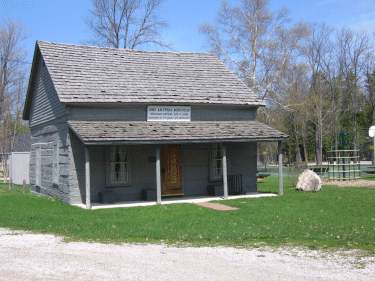


Old Presque Isle Lighthouse (by Flickr user jackdk)

Thursday, July 8, 2010

The Resort Days

Our area is well-known as a tourist destination, and many of our outlying areas and lakes were exclusively resort areas long before permanent, year-round, settlement. Here are some postcards of the early resorts of our area. Some of them are long gone and forgotten, and some are still around.

ADRIAN RESORT HOTEL - Long Lake


Doesn't this place look grand? I can find no mention of this place in any of my books or online. There are no Adrian property owners along Long Lake in the 1903 Plat Book. Since this photo was taken in summer 1908, I can only guess that Mr. Adrian dumped his life savings and months of back breaking labor on this beautiful place, just in time for it to be destroyed by the Metz Fire a few months later in October.


BIRCH HILL HOTEL - Grand Lake


This hotel was built in the late 1890s and opened in 1901, owned and built by Joe Kauffman, brother of George F Kauffman who built the Fireside Inn. It was in operation until the 1960s. I'm not sure of the exact location on Birch Hill though I would assume it's on the site of the current Birch Hill Resort.


FIRESIDE INN - Grand Lake


This resort was built by George F Kauffman in 1908, at the pleading of his wife who had saved up $350 to build it. He was at first reluctant because his brother Joe already owned the Birch Hill Hotel and he did not want to compete with him, but eventually he caved in. They used their $350 along with the unlimited free timber around them and their own labor to complete the hotel. This resort is still in operation today, and I worked there every summer during my high school years.


PRESQUE ISLE LODGE - Grand Lake


This hotel was built in 1920 by Newell A Eddy, Jr - partially as a place to showcase the family's handmade furniture which fills the Lodge today. It was the 4th resort to be erected at Grand Lake. Despite being closed for a number of years, the resort re-opened several years ago and is a very popular inn for tourists and event venue for locals.


Two other resorts I can't find much information or any photos on are the Grand Lake Hotel and the Colony Bar. The Grand Lake Hotel was owned by Bliss Stebbins, and was eventually split up, then converted into a private residence. I know nothing of the Colony Bar other than it was one of the 4 original resorts on Grand Lake.

Tuesday, June 29, 2010

Using Maps to Paint a Picture

One of the things I've been doing to better visualize what our area used to look like is using the 1903 Plat book and current day Google Maps to find where the homes/schools/post offices, etc of the day were on a modern day map. It helps to paint a picture of which people were neighbors, which landmarks they lived near, and where they would have gone to school and conducted business.

This week, in my Bell frenzy, I started a map showing what Presque Isle Township looked like in 1903. I will publish the link when I have more done, but here's the basic idea:


The colored rectangles are the acreage owned by the residents and the house icons are their homes. When you click on an icon, the description will pop up - the Bell School is selected for example. Upon zooming in, you get very detailed aerial shots and are able to see the exact locations of homes, outlines of old roads, and clearings where buildings used to stand. This tool has proven most useful in providing me with a picture of what the community was like over 100 years ago.

I'm also working on a broader map of Presque Isle County which includes churches, cemeteries, schools, lumber mills, and other landmarks. The focus of this one is more on landmarks and less on land ownership because it is so big. The map does however include photos of almost every schoolhouse, church, and cemetery left standing among other landmarks, thanks to BJ over at Presque Isle County GenWeb who is taking photos for me in my absence. I hope someday to plat out the entire county.


The process of creating these maps can be tedious and time-consuming, but it's well worth it to me because it makes it easier for us to relate to the people and places of the past when we're able to compare them against modern-day landmarks.

The Village of Bell: As if it Never Existed

Many people in our area have heard of, or visited, Besser Natural Area off of Grand Lake Road in Presque Isle Township. Jesse Besser bestowed this land to the public in 1966 because it was the only virgin pine stand in the area that had not either been cut down in the old logging days or destroyed by the Metz Fire of 1908.

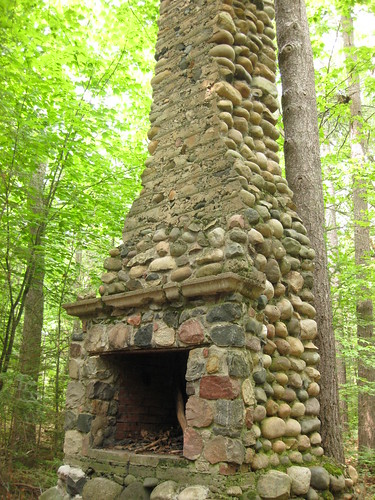
Most people know there is a trail, the old road that used to loop around the small peninsula at the edge of the bay, which is a popular destination for tourists and locals alike. Along the trail are a few reminders of civilization including a lonely stone chimney, a sign, and other scattered debris.

(images in this post from Flickr user bmcirillo)

There is also a cemetery, with only one remaining original grave, which was lovingly restored in the 1980s and given fences and one stone with the names of some of those known to be buried there. I am currently working with the current keeper of Presque Isle Township history to provide her the dates of death of these people and find the unknown burials. More about that later!


It is a very common misconception that the village of Bell existed entirely within the Besser Natural Area. That couldn't be further from the truth, as I discovered this week. In comparing the 1903 Plat Map against a current-day aerial Google Map, I found that most of Bell was actually found along the stretch of Grand Lake Road between the Township Hall and the Hide-a-way! The school, the post office, and most of Bell's known residents can all be found along that stretch of road. This is great news, because it means there's actually a lot more left of Bell than we realized. It means that those who built the historic farms along the road were citizens of Bell, and some of their homes are still intact!

When I decided to do something to find out more about these lost residents and the logging town they called home, I was very surprised and disheartened to find out that there is only a very small amount of information available on the topic. It has become clear that many people are interested in knowing more about the lost village of Bell, and I am very excited to participate in helping find and share information with the public.

Look for many more posts on Bell and the people who once called it home. I'm currently pouring a lot of my energy into the subject and will be posting my findings here. Follow me and be the first to know when new info is available!